Thursday 1 December 2005
4.30pm in Seminar Room 2
Professor Helen King (University of Reading)
'Women's bodies in sixteenth-century medicine: using the classical tradition'
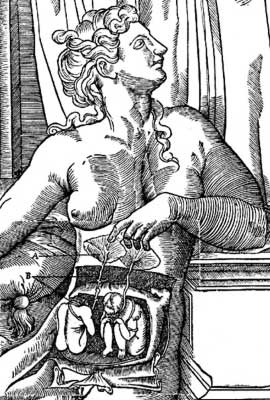 Before
the discovery of the ovum, how was women's contribution to generation
envisaged? While women could be seen as merely containers for male seed,
other Western traditions gave menstrual blood a key role, making
menstruation not evidence of failure to generate, but an essential
element of generation. This talk will examine the uses made of the
Hippocratic and Galenic texts on gynaecology and reproduction in the
sixteenth century. It will focus on the work of the Galenist Sylvius
(Jacques DuBois) on generation and menstruation (1555); Sylvius taught
at Paris, and was physician to Henri II, and to the royal children. In
the French translation (1559), made by Guillaume Chrestien, physician in
ordinary to the Duke of Bouillon, and subsequently to François I and to
Henri II, the section on generation is dedicated to the future François
II on his marriage, and that on menstruation to Diane de Poitiers.
Chrestien's preface is also very Galenic in content, despite his
reference to 'Father Hippocrates, author of all those good things which
we have in the art of medicine', and gives us a valuable insight into
the gendering of both medical knowledge and medical care. I will argue
that recent work claiming to identify change in seventeenth- and
eighteenth-century notions of generation, and to tie this to very
specific social and economic changes, overlooks the important and
lasting contribution made by classical Greek and Roman texts.
Before
the discovery of the ovum, how was women's contribution to generation
envisaged? While women could be seen as merely containers for male seed,
other Western traditions gave menstrual blood a key role, making
menstruation not evidence of failure to generate, but an essential
element of generation. This talk will examine the uses made of the
Hippocratic and Galenic texts on gynaecology and reproduction in the
sixteenth century. It will focus on the work of the Galenist Sylvius
(Jacques DuBois) on generation and menstruation (1555); Sylvius taught
at Paris, and was physician to Henri II, and to the royal children. In
the French translation (1559), made by Guillaume Chrestien, physician in
ordinary to the Duke of Bouillon, and subsequently to François I and to
Henri II, the section on generation is dedicated to the future François
II on his marriage, and that on menstruation to Diane de Poitiers.
Chrestien's preface is also very Galenic in content, despite his
reference to 'Father Hippocrates, author of all those good things which
we have in the art of medicine', and gives us a valuable insight into
the gendering of both medical knowledge and medical care. I will argue
that recent work claiming to identify change in seventeenth- and
eighteenth-century notions of generation, and to tie this to very
specific social and economic changes, overlooks the important and
lasting contribution made by classical Greek and Roman texts.
There will be tea before the lecture, at 4.15pm in Seminar Room 1, and a drinks reception afterwards, at 6pm in Seminar Room 1.
Workshop
11.30–1.00 in Seminar Room 1
'William Smellie vs John Burton: using the history of medicine in eighteenth-century obstetrics'
Professor King will introduce a discussion of a pre-circulated paper. All welcome!