Vivid comparisons
Embryology was crucial to Haeckel’s Darwinism, but if the science was to become the core of a new world-view, striking pictures were essential.
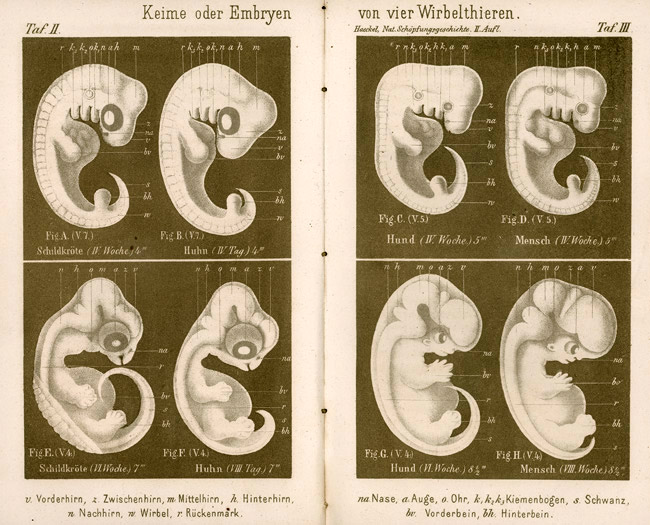
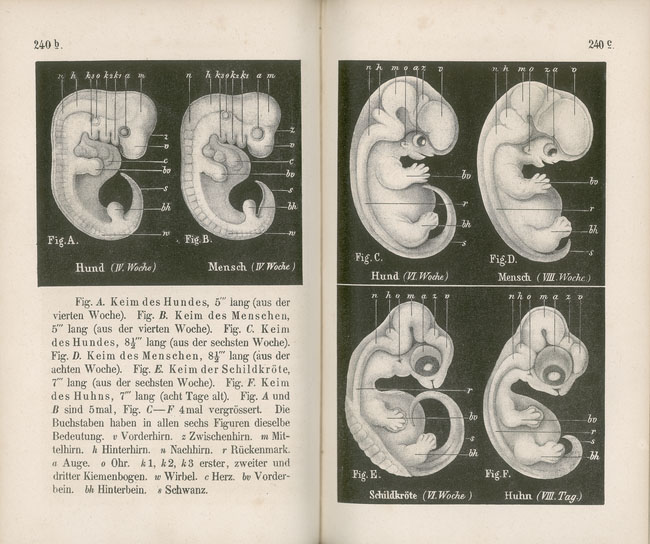
Haeckel wanted new and more impressive illustrations. In his experience as a teacher even medical students often found embryology unfamiliar, difficult and dry. No existing figure allowed more than a couple of species easily to be compared. So for his Natural History of Creation, the first Darwinist system for the general educated public and one of the most successful of all evolutionary works, he designed pictures that compared vertebrate embryos more vividly than ever before.
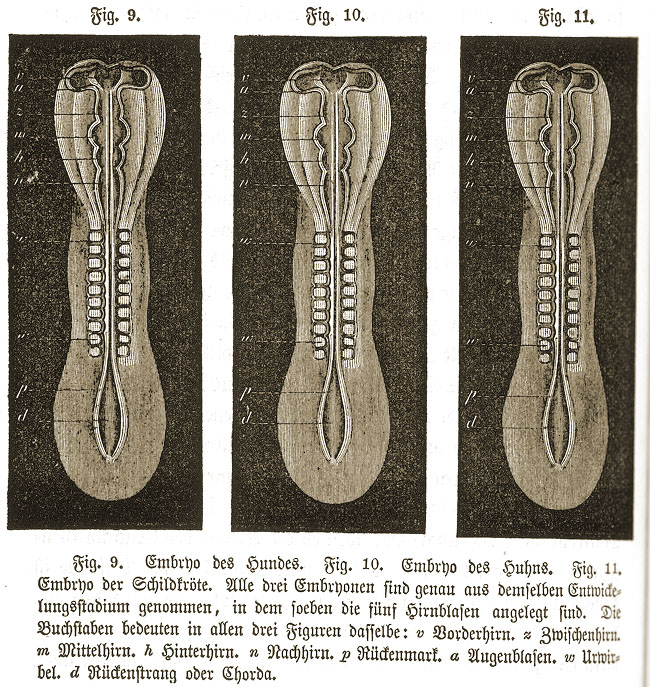
Haeckel took some liberties. For a wood-engraving, he naughtily had one block printed three times to represent the embryos of three different species. For a lithographic plate, he undertook an unusually wide synthesis in order to represent species-types, but the real innovation was to put them together into striking arrays. He also exaggerated their similarity into identity and surrounded it with provocative liberal polemic. Noblemen might fancy themselves a breed apart, he wrote, but for the first two months of development, even bluebloods were indistinguishable from dogs.
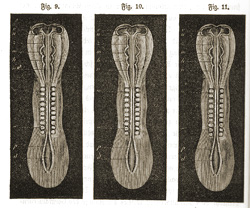
Embryos of dog, chick and turtle printed from the same block, 1868 |
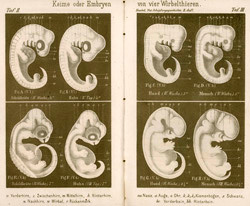
Haeckel’s first embryological grid, 1870 |